

Sprinkler System Impairment - a guide to responsibilities
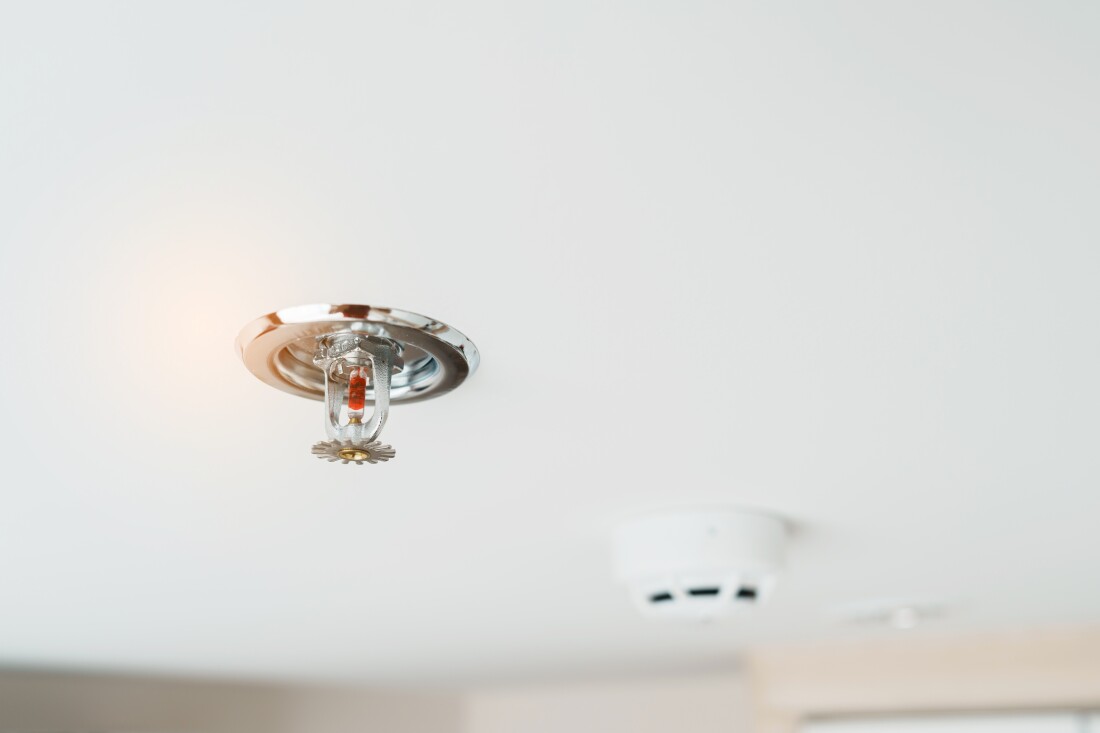


Where premises are fitted with automatic fire suppression systems (AFSS) whether for the safety of occupants or the protection of property, any situation where these systems are impaired needs to trigger a range of responses from the property occupier and/or owners.
Where systems are installed for the safety of occupants, then it’s likely that any system impairment which results in injury may render the property owner or responsible person liable to prosecution.
1 Article 17(1) Regulatory Reform (Fire Safety) Order 2005. The devolved governments have similar legislation. (See Note 1 for actual wording). The extension of legislation to cover requirements for AFSS in much residential accommodation means that where the systems are not immediately available, then a criminal offence may be committed.
Where the fire strategy for a building is dependent on the presence of an AFSS, its non-availability usually means that the premises should be closed until the system impairment is rectified. (This is why the UK version of BSEN 12845 includes an Annex F which sets out additional design measures to reduce the possibility of a sprinkler system being out of service during maintenance).
Where protection is liable to be non-operational for some hours, there are several actions which must be taken by the owner of the protected premises or persons employed by them. Where suppression systems are installed for insurance purposes, underwriters will be particularly concerned should protection not be available.
Property insurers invariably impose obligations on insured persons via policy wording, either as a warranty or a condition precedent.
- Non-compliance with a condition precedent allows an insurer to void cover, in respect of any impairment of a sprinkler or other fire suppression system. There are two specified duties which will be a feature of all insurance policy wordings where the presence of sprinklers is mandated or where a premium discount has been allowed in respect of the fitting of sprinklers. Note that all standard policy wordings will also include a requirement to ensure that the sprinkler system is subject to regular checks and tests by a competent person and ‘maintained in good working order at all times’ implicitly or explicitly in conformity with published standards’ - such as BS EN 12845 for industrial and commercial sprinkler systems or BS EN 14972 for water mist systems.
All policy wordings will refer at least to the following actions to be complied with by an insured person when a sprinkler system is not available:
1. To advise the local fire and rescue service; and
2. To inform the insurers.
There are other actions which can usefully be taken because of unplanned shutdowns, and these are summarised in Annex J of BS EN 12845:2019. For projects where compliance with the LPC Rules for Automatic Sprinkler Installations are called up then the contents of TB203-6 should be complied with in addition to the requirements of Annex J, notwithstanding the references to ‘Maintenance’ in the TB.
In respect of water mist installations, any specific requirements in the system’s Design, Operation and Maintenance Manual should be complied with and the guidance in Annex J of BS 12845 should be followed where relevant.
Sensible precautions include the following:
- Inform insurers and fire authority and tenants/neighbours
- Implement planned shutdown procedures
- Minimise the possibility of a fire occurring
- Patrol the area affected continuously
- Prohibit hot work
- Impose a strict permit system on all other maintenance
- Prohibit smoking and naked lights in the vicinity of the building
- Minimise the possibility of a fire spreading by closing fire doors and shutters
- Augment the availability of fire extinguishers and ensure that there are sufficient trained personnel available to handle them.
Recent civil cases determined under English Law (see also Note 2) have gone further than Annex J and there is a consensus among fire protection experts in the UK that the following obligations should be complied with in the event of a sprinkler system impairment:
- A formal, written procedure must be in place to deal with any impairment of the fire protection systems
- These procedures should be based around the guidelines contained in Annex J of BS EN 12845 (2019)
- Continuous patrols by security guards/competent staff etc
- Cessation of hazardous activities including all hot work and any routine maintenance activity
- Operation of power equipment including cranes, conveyors, forklift trucks etc.
- Notification of interested parties including insurers/tenants
- Ensure that all fire detection and alarm systems are in working order and that links to alarm receiving centres are tested
- Consider whether the premises should be closed or their use by visitors restricted
Responsibility for managing system impairments
In respect of legislation compliance, the ‘Responsible Person’ or duty holder is deemed to have the onus of managing all fire safety matters, including the Article 17 responsibilities for maintenance (See Note 1 below). However, this may be a shared duty in some properties or businesses, and modern commercial property management approaches may complicate things further.
The November 2005 fire at a 40,000 m2 warehouse at Magna Park, Lutterworth encapsulates the issues admirably. The warehouse building co-owned by a pension fund, administered by an insurer; the actual building was insured by a different company.
Primark were tenants, the contents of the building were insured by different underwriters The whole facility was operated by TNT, their liability limited by contract Warehouse operations, safety and security, M&E services, building maintenance and cleaning were all contracted to third party providers by TNT. Overall site security, site access, grounds maintenance and sprinkler and hydrant firefighting water was provided by Magna Park Ltd. The fire systems maintenance was outsourced to three separate companies. The sprinkler system failed to operate as the common water supply was disconnected due to damage to underground pipes serving the warehouse. Note that the fire which reportedly caused damage to the building and contents costing more than £100 million fire occurred before the Fire Safety Order came into effect.
Note 1:
“17.—(1) Where necessary in order to safeguard the safety of relevant persons the responsible person must ensure that the premises and any facilities, equipment and devices provided in respect of the premises under this Order … are subject to a suitable system of maintenance and are maintained in an efficient state, in efficient working order and in good repair”.
Note 2:
The 2023 US case of Frankenmuth Mutual insurance Co. v. Fun F/X II Inc. and Cao Enterprises II LLC [601 F. Supp. 3d 330, 343–44 (N.D. Ind. 2022)] found that the property insurer was not liable to indemnify the claimants following a 2019 fire. The insurers relying on a policy exclusion for failing to inform the insurer of impairments in the protective systems - the sprinkler system water supply had been disconnected. The judgment was confirmed on appeal. While not directly binding on a UK court this precedent would be very persuasive in similar circumstances.